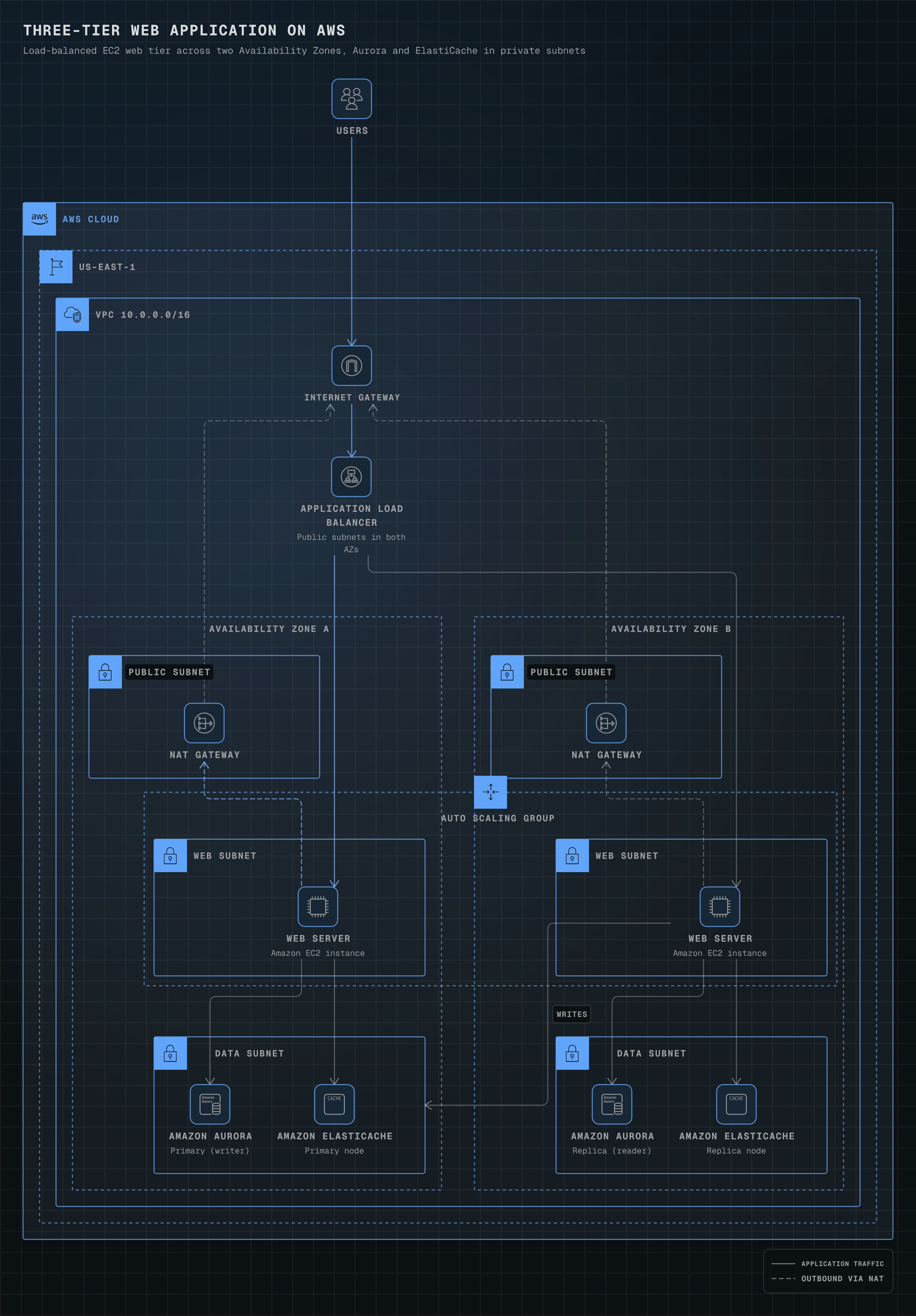
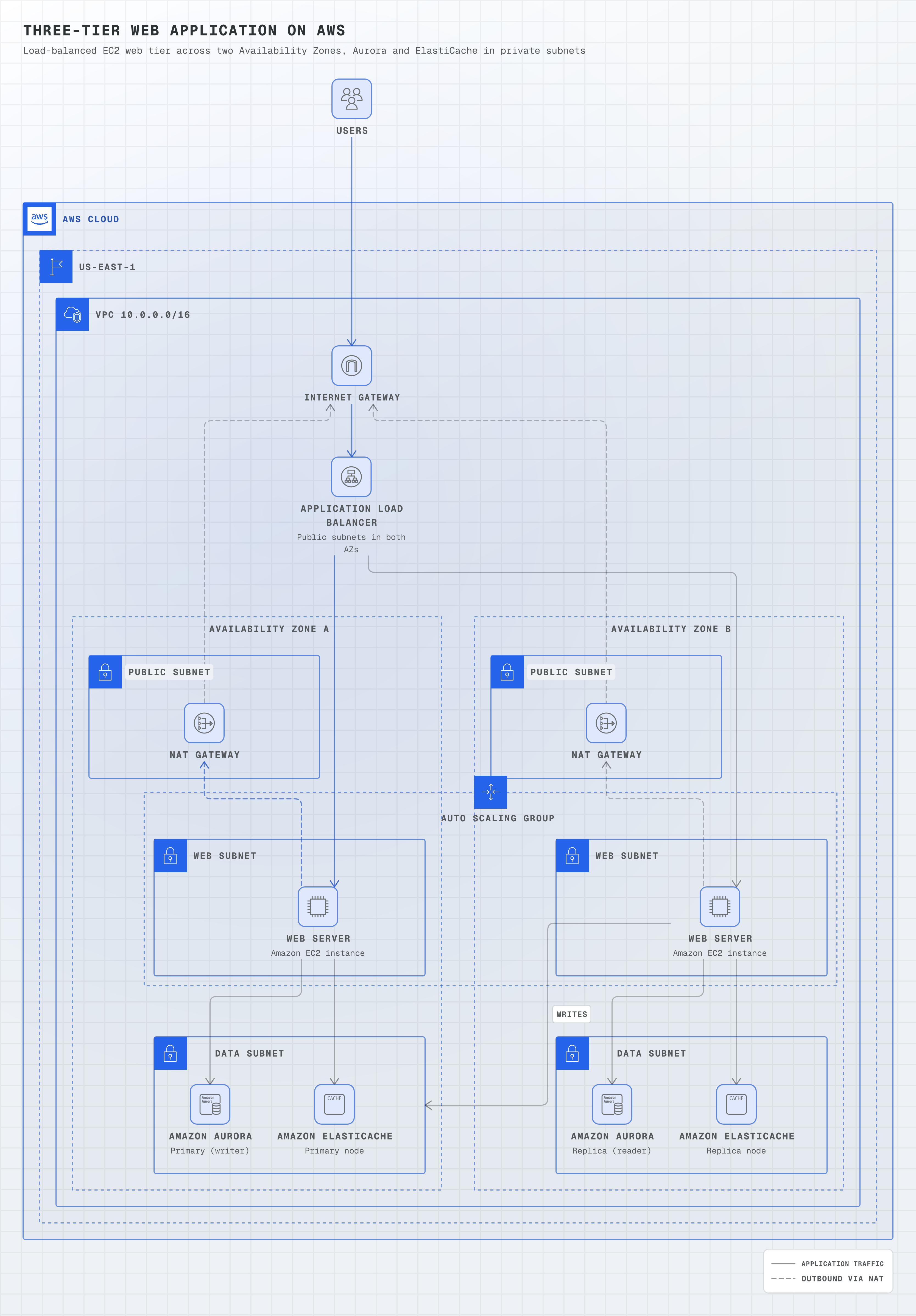
Three-tier web application on AWS
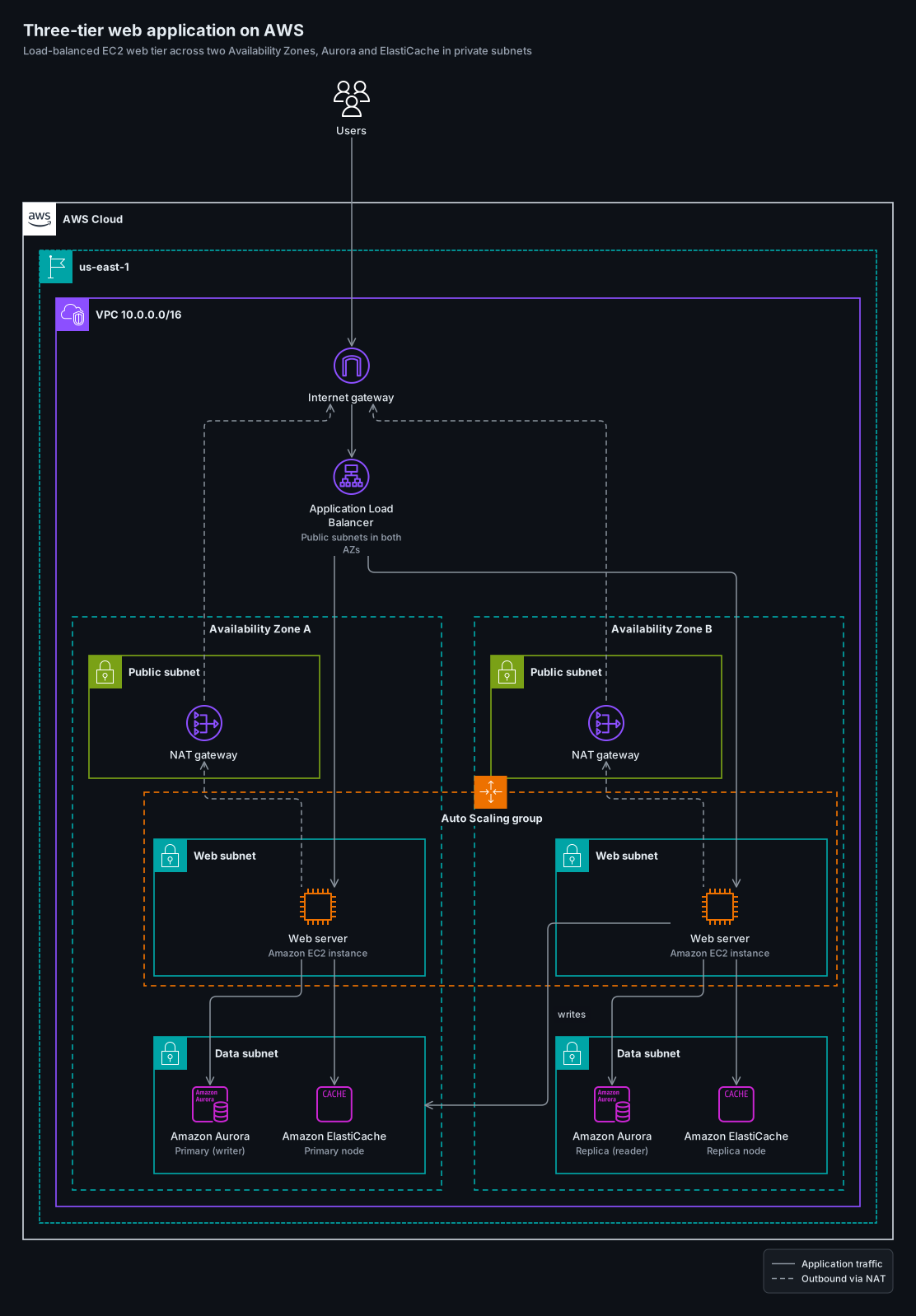
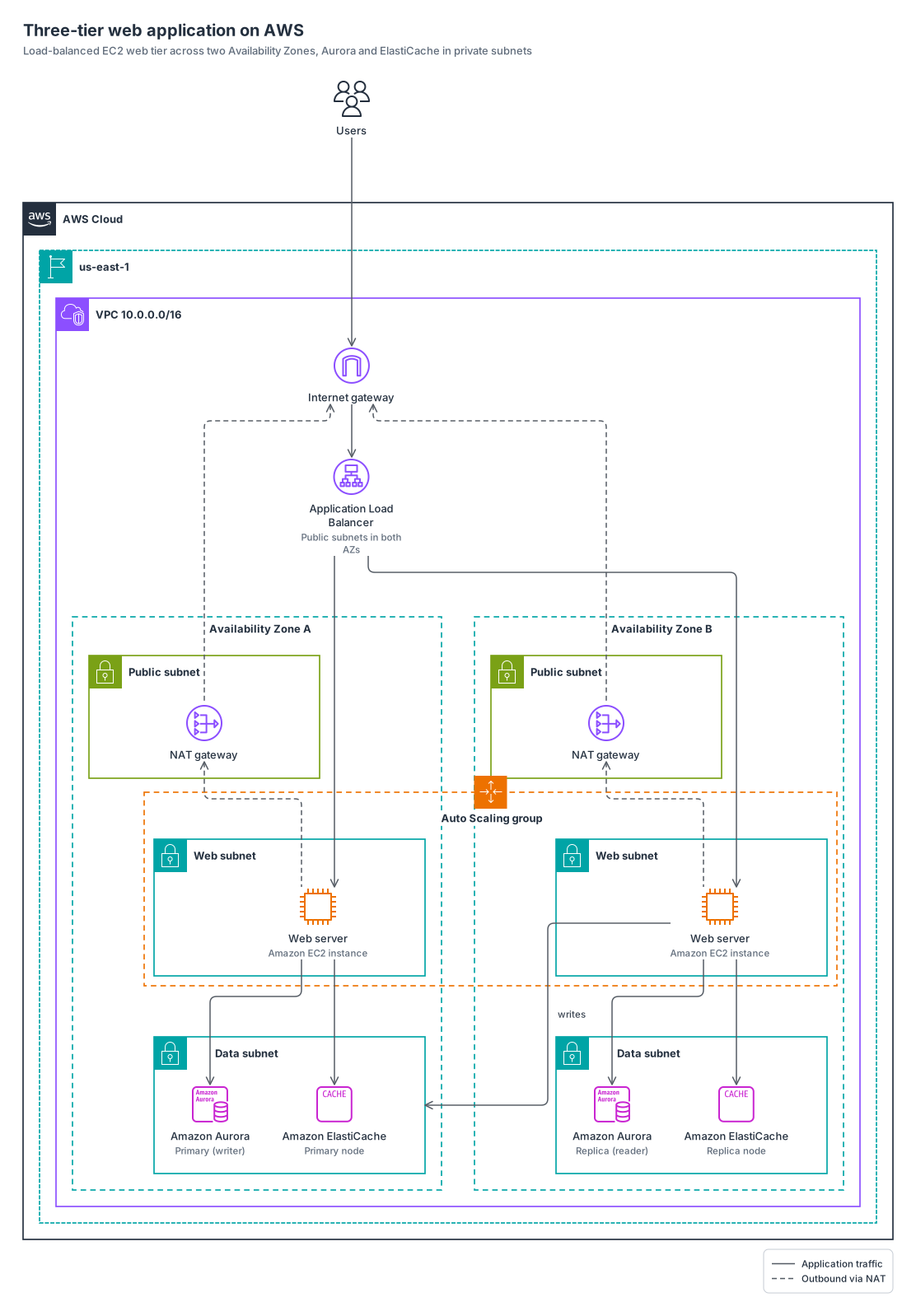
a VPC across two Availability Zones with public, web and data subnets, NAT gateways, an ALB, and one Auto Scaling group drawn across both zones with `around:`; zone B writes to the primary database in zone A.
aws11 nodes12 groups8 edges
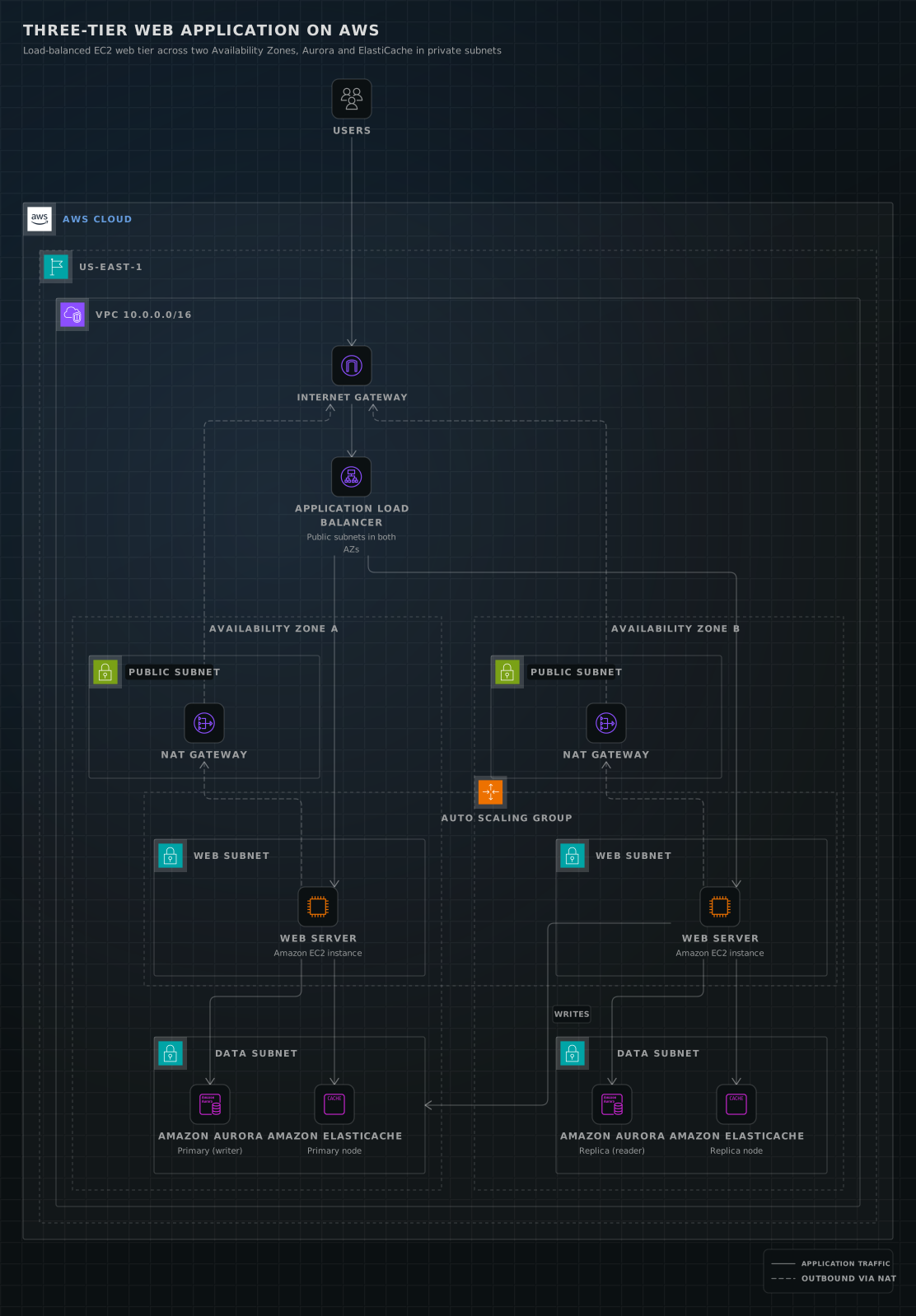
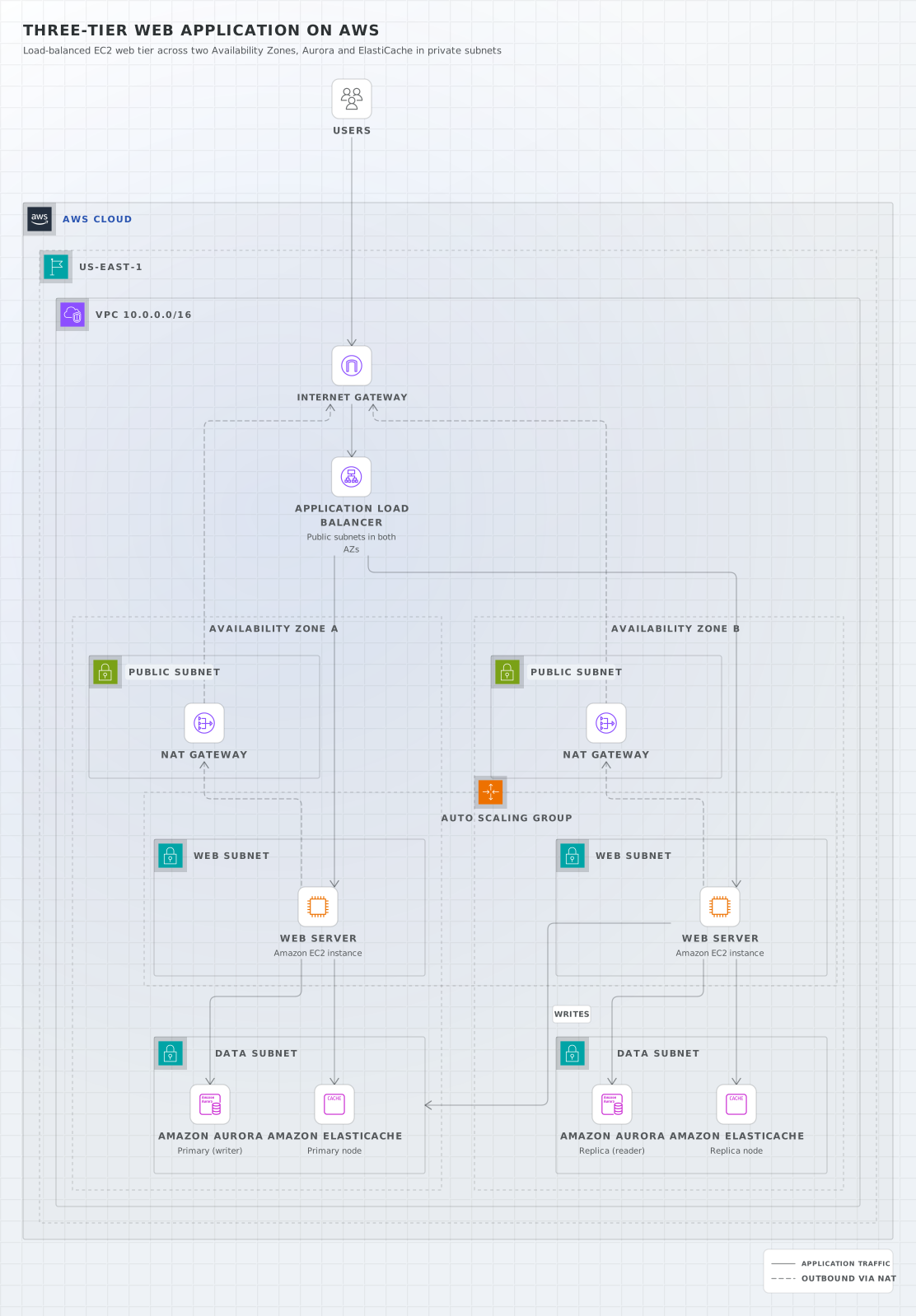
aws-three-tier.yamlOn GitHub
# yaml-language-server: $schema=../references/diagram.schema.json
title: Three-tier web application on AWS
subtitle: Load-balanced EC2 web tier across two Availability Zones, Aurora and ElastiCache in private subnets
direction: down
# merge: false gives each edge its own port: the two NAT paths would otherwise share one arrowhead
# at the internet gateway.
layout: { merge: false }

legend:
  solid: Application traffic
  dashed: Outbound via NAT

groups:
  cloud: { type: aws:cloud }
  region: { type: aws:region, label: us-east-1, in: cloud }
  vpc: { type: aws:vpc, label: VPC 10.0.0.0/16, in: region }
  az-a: { type: aws:az, label: Availability Zone A, in: vpc }
  az-b: { type: aws:az, label: Availability Zone B, in: vpc }
  public-a: { type: aws:public-subnet, label: Public subnet, in: az-a }
  public-b: { type: aws:public-subnet, label: Public subnet, in: az-b }
  app-a: { type: aws:private-subnet, label: Web subnet, in: az-a }
  app-b: { type: aws:private-subnet, label: Web subnet, in: az-b }
  data-a: { type: aws:private-subnet, label: Data subnet, in: az-a }
  data-b: { type: aws:private-subnet, label: Data subnet, in: az-b }
  # One Auto Scaling group spans both zones: an overlay that does not move its members.
  asg: { type: aws:auto-scaling, around: [app-a, app-b] }

nodes:
  users: { icon: aws:users, label: Users }
  igw: { icon: aws:igw, label: Internet gateway, in: vpc }
  alb: { icon: aws:alb, label: Application Load Balancer, note: Public subnets in both AZs, in: vpc }
  nat-a: { icon: aws:nat, label: NAT gateway, in: public-a }
  nat-b: { icon: aws:nat, label: NAT gateway, in: public-b }
  web-a: { icon: aws:ec2-instance, label: Web server, note: Amazon EC2 instance, in: app-a }
  web-b: { icon: aws:ec2-instance, label: Web server, note: Amazon EC2 instance, in: app-b }
  db-a: { icon: aws:aurora-instance, label: Amazon Aurora, note: Primary (writer), in: data-a }
  db-b: { icon: aws:aurora-instance, label: Amazon Aurora, note: Replica (reader), in: data-b }
  cache-a: { icon: aws:elasticache-cache-node, label: Amazon ElastiCache, note: Primary node, in: data-a }
  cache-b: { icon: aws:elasticache-cache-node, label: Amazon ElastiCache, note: Replica node, in: data-b }

edges:
  - users -> igw -> alb
  - alb -> web-a, web-b
  # Outbound traffic goes up through the NAT gateways; written in layout order (NAT first)
  # with the arrow at the start, so the public subnets stay above the private ones.
  - { from: igw, to: [nat-a, nat-b], arrow: start, line: dashed }
  - { from: nat-a, to: web-a, arrow: start, line: dashed }
  - { from: nat-b, to: web-b, arrow: start, line: dashed }
  - web-a -> db-a, cache-a
  - web-b -> db-b, cache-b
  # Zone B writes go to the primary Aurora and ElastiCache nodes in zone A. constraint: false keeps
  # this edge out of the layout, so the zones stay side by side.
  - { from: web-b, to: data-a, label: writes, constraint: false }
Start from this one
Copies the spec to diagram.yaml, then renders every format.
$ orrery init aws-three-tier$ orrery render diagram.yaml -f all --theme both