Retrieval augmented generation on Azure
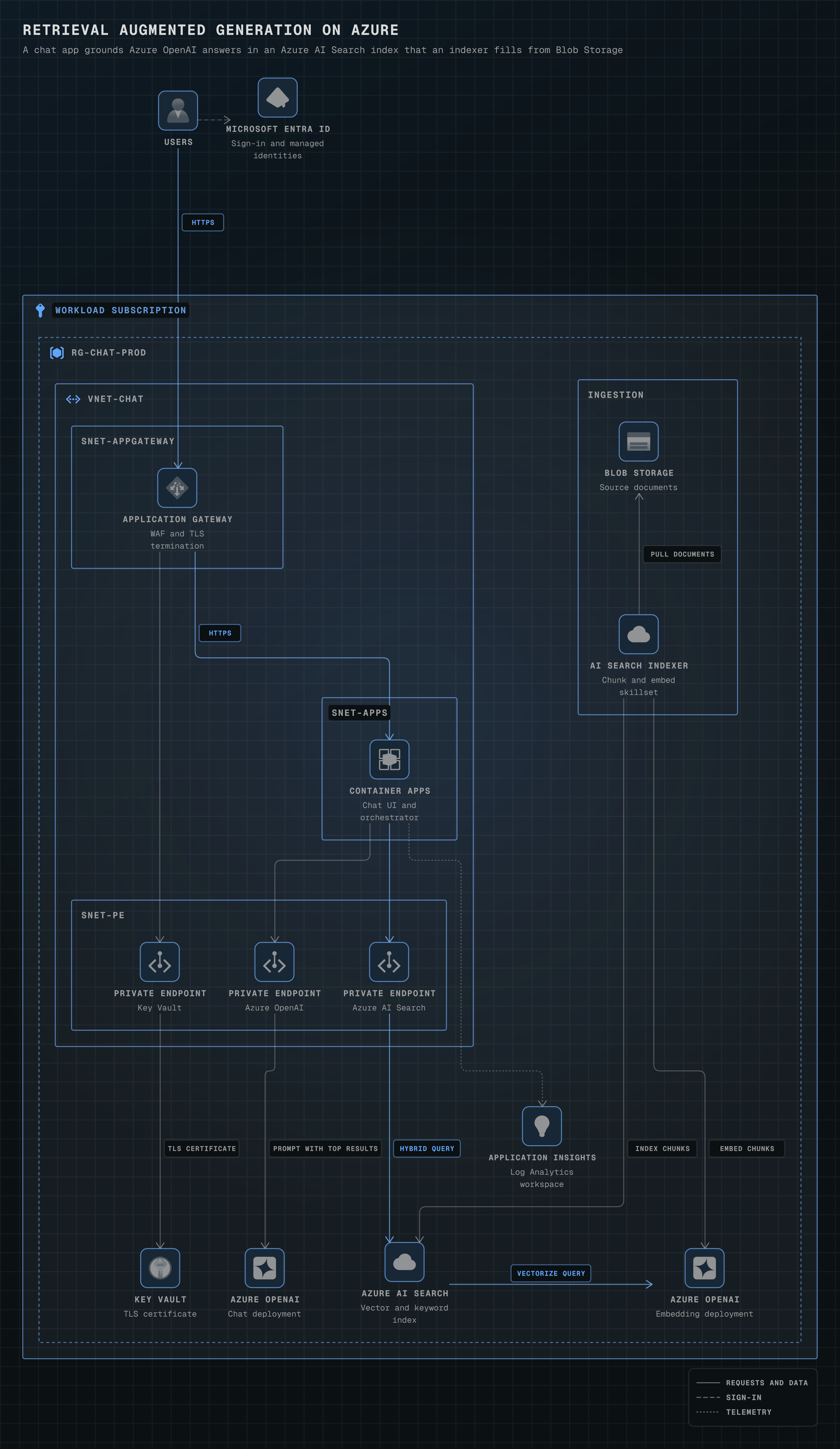
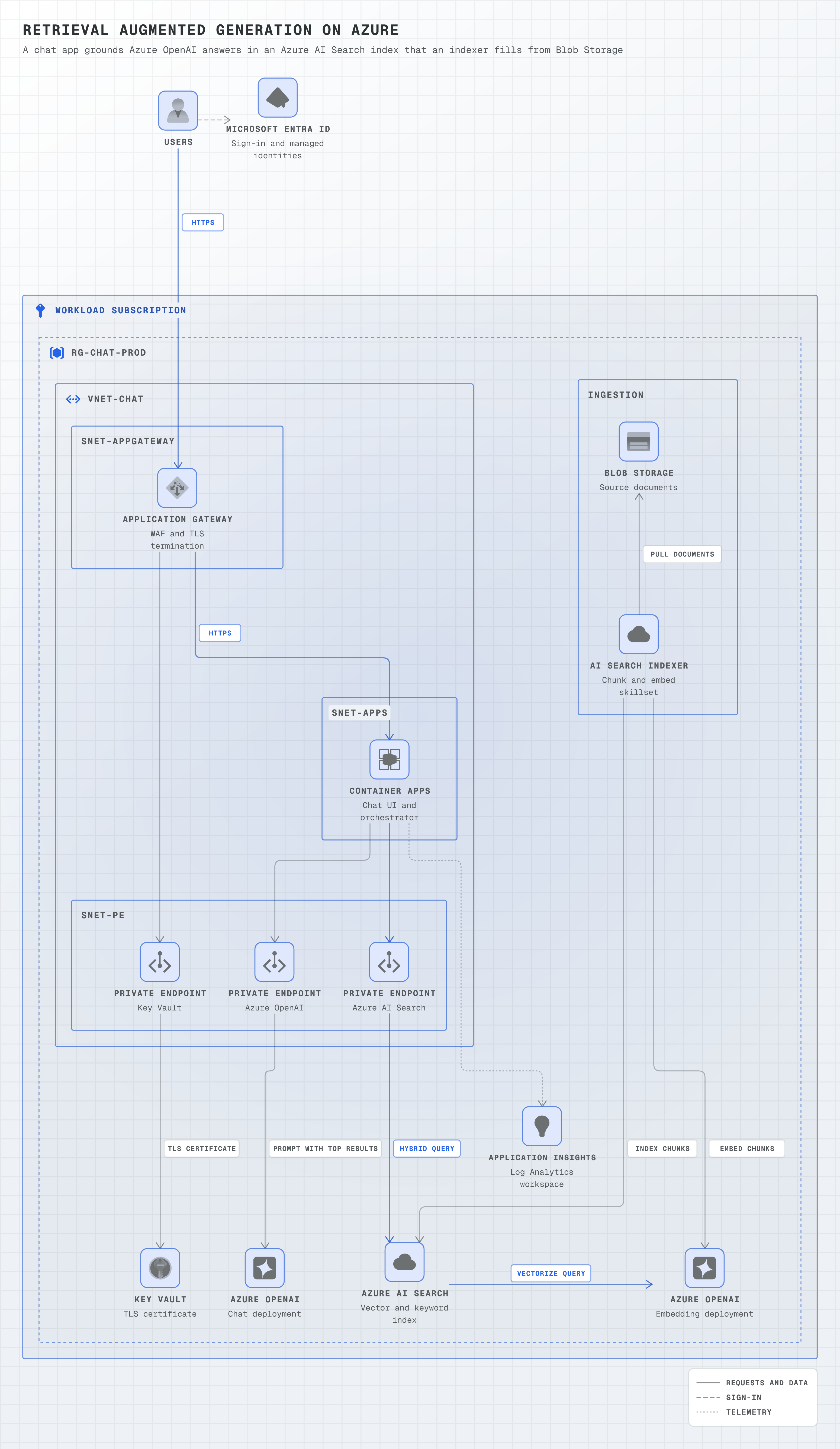
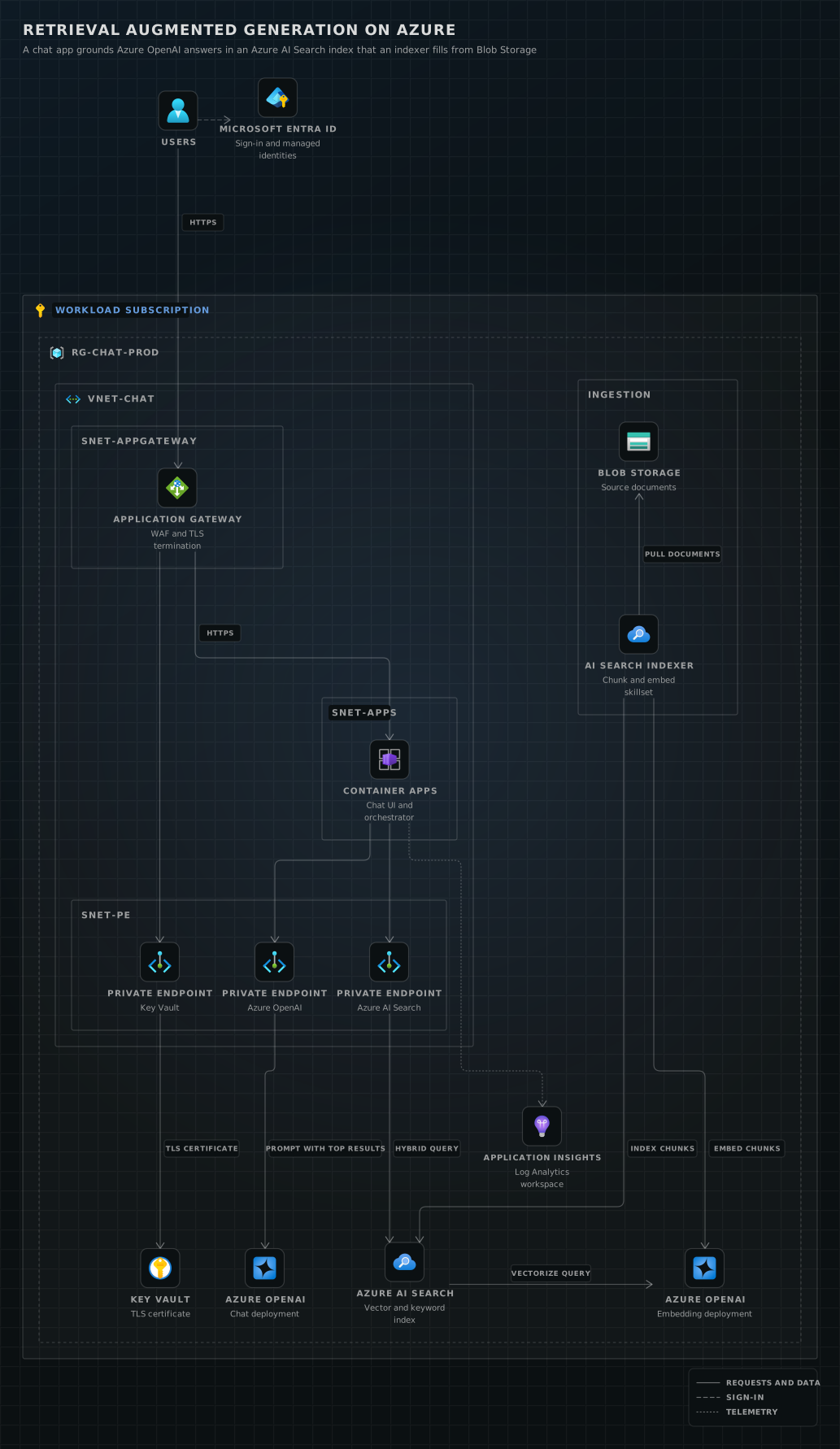
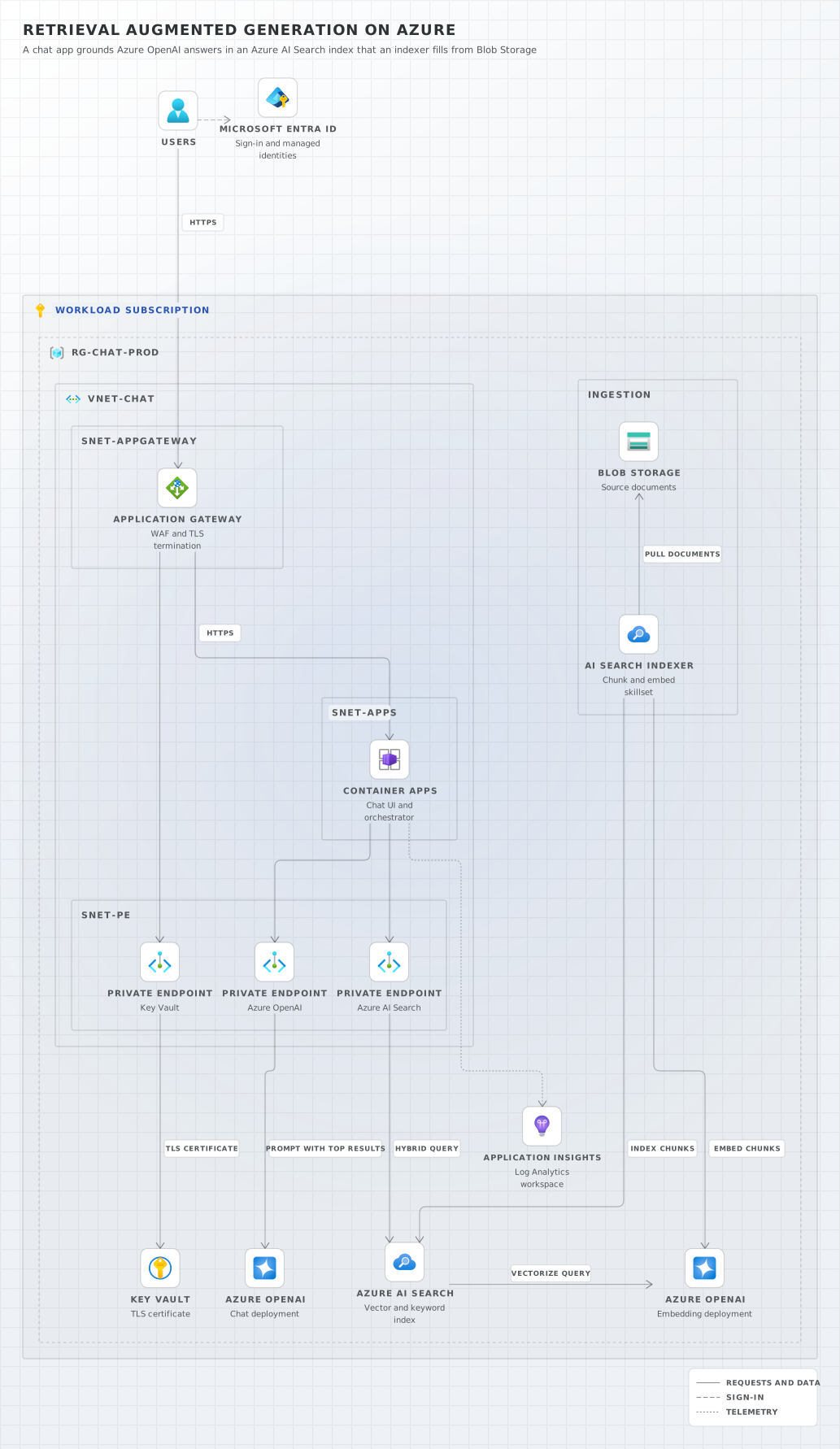
Azure OpenAI chat grounded in an Azure AI Search index, behind Application Gateway and private endpoints, with an indexer filling the index from Blob Storage.
azure14 nodes7 groups14 edges
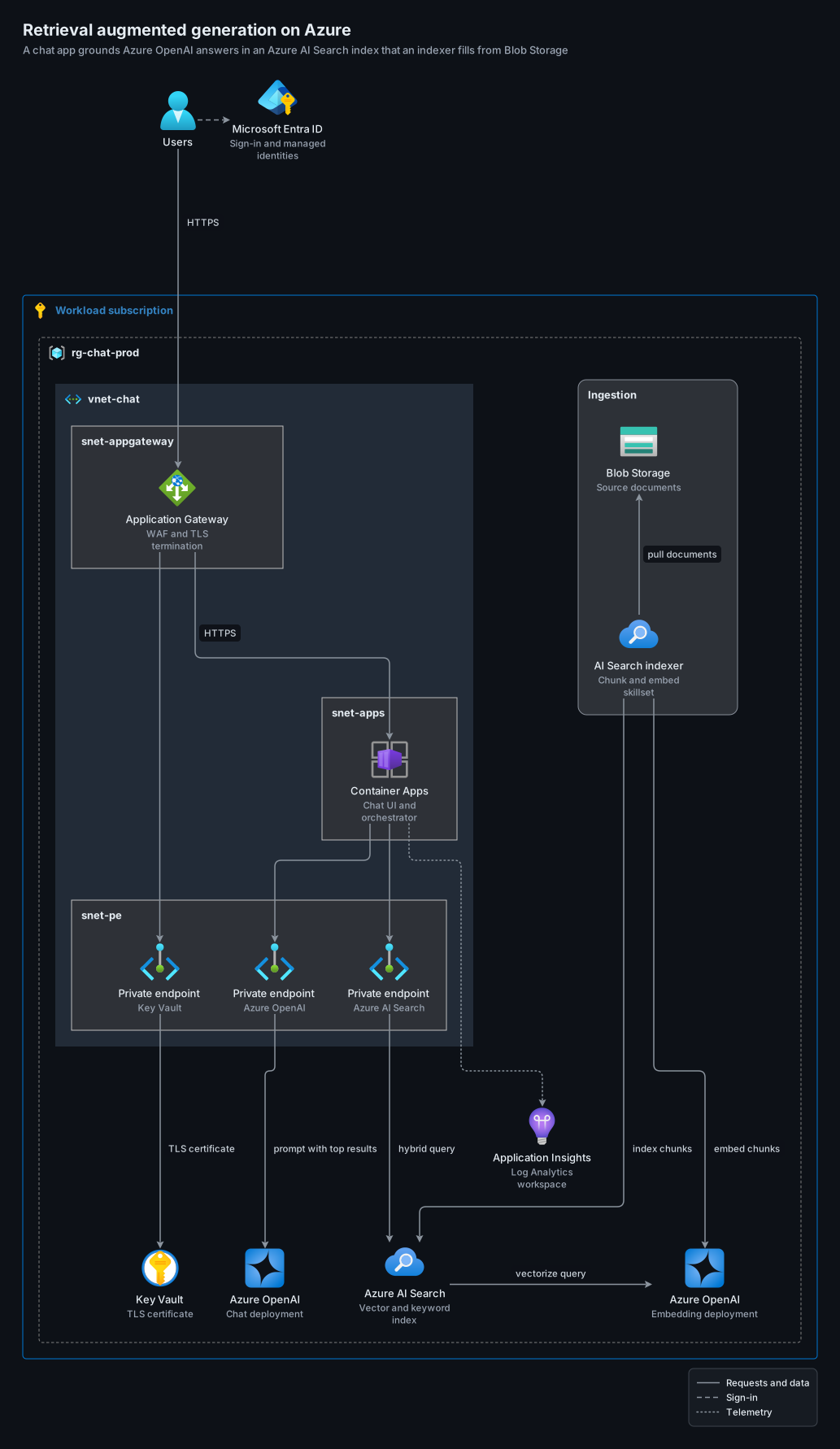
azure-openai-rag.yamlOn GitHub
# yaml-language-server: $schema=../references/diagram.schema.json
title: Retrieval augmented generation on Azure
subtitle: A chat app grounds Azure OpenAI answers in an Azure AI Search index that an indexer fills from Blob Storage
direction: down
# Filled triangles, as in Azure's reference diagrams; one port per edge.
arrowhead: filled
layout: { merge: false }

legend:
  solid: Requests and data
  dashed: Sign-in
  dotted: Telemetry

groups:
  sub: { type: azure:subscription, label: Workload subscription }
  rg: { type: azure:resource-group, label: rg-chat-prod, in: sub }
  vnet: { type: azure:vnet, label: vnet-chat, in: rg }
  snet-agw: { type: azure:subnet, label: snet-appgateway, in: vnet }
  # Microsoft's baseline chat architecture hosts the UI on App Service, a PaaS service outside the VNet.
  # An internal Container Apps environment is injected into its own subnet instead, so the app runs inside the VNet.
  snet-aca: { type: azure:subnet, label: snet-apps, in: vnet }
  snet-pe: { type: azure:subnet, label: snet-pe, in: vnet }
  ingestion: { type: zone, label: Ingestion, in: rg }

nodes:
  users: { icon: azure:users, label: Users }
  entra: { icon: azure:entra-managed-identities, label: Microsoft Entra ID, note: Sign-in and managed identities }
  kv: { icon: azure:key-vaults, label: Key Vault, note: TLS certificate, in: rg }
  agw: { icon: azure:application-gateways, label: Application Gateway, note: WAF and TLS termination, in: snet-agw }
  app: { icon: azure:container-apps-environments, label: Container Apps, note: Chat UI and orchestrator, in: snet-aca }
  pe-kv: { icon: azure:private-endpoint, label: Private endpoint, note: Key Vault, in: snet-pe }
  pe-oai: { icon: azure:private-endpoint, label: Private endpoint, note: Azure OpenAI, in: snet-pe }
  pe-search: { icon: azure:private-endpoint, label: Private endpoint, note: Azure AI Search, in: snet-pe }
  docs: { icon: azure:storage-accounts, label: Blob Storage, note: Source documents, in: ingestion }
  # The indexer runs inside Azure AI Search and reaches Blob Storage and the embedding
  # deployment through shared private links, not through the workload VNet.
  indexer: { icon: azure:cognitive-search, label: AI Search indexer, note: Chunk and embed skillset, in: ingestion }
  insights: { icon: azure:application-insights, label: Application Insights, note: Log Analytics workspace, in: rg }
  chat: { icon: azure:azure-openai, label: Azure OpenAI, note: Chat deployment, in: rg }
  index: { icon: azure:cognitive-search, label: Azure AI Search, note: Vector and keyword index, in: rg }
  embed: { icon: azure:azure-openai, label: Azure OpenAI, note: Embedding deployment, in: rg }

edges:
  # Sign-in and the vectorizer call stay out of the layout, so they run sideways instead of adding rows.
  - { from: users, to: entra, line: dashed, constraint: false }
  - users -> agw: HTTPS
  - agw -> pe-kv
  - pe-kv -> kv: TLS certificate
  - agw -> app: HTTPS
  - app -> pe-oai
  - app -> pe-search
  - pe-oai -> chat: prompt with top results
  - pe-search -> index: hybrid query
  # The index's vectorizer turns the query text into a vector with the same embedding model.
  - { from: index, to: embed, label: vectorize query, constraint: false }
  # The indexer pulls from Blob Storage on a schedule, so the arrow starts at the indexer.
  - { from: docs, to: indexer, arrow: start, label: pull documents }
  - indexer -> index: index chunks
  - indexer -> embed: embed chunks
  - app ..> insights
Start from this one
Copies the spec to diagram.yaml, then renders every format.
$ orrery init azure-openai-rag$ orrery render diagram.yaml -f all --theme both