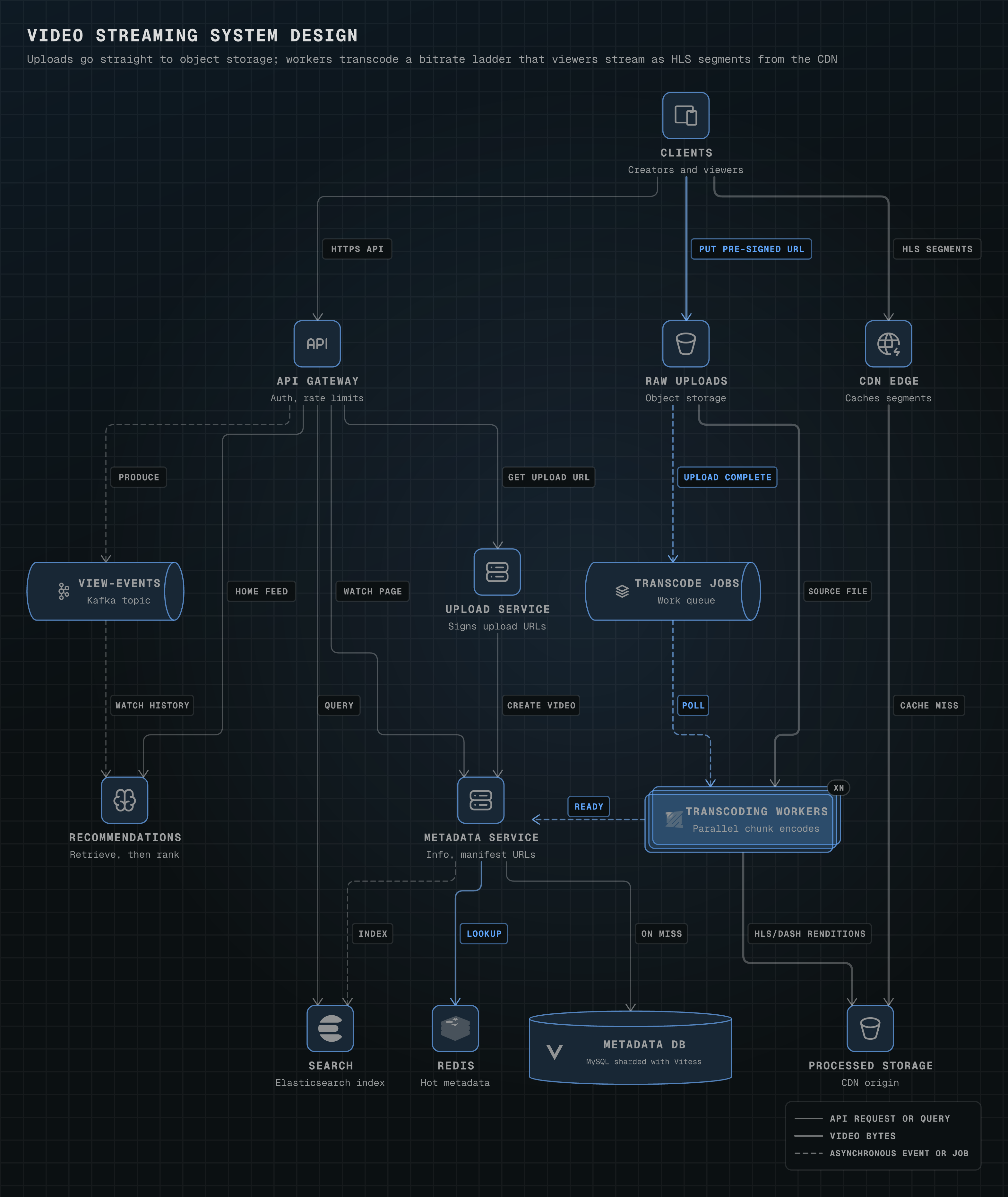
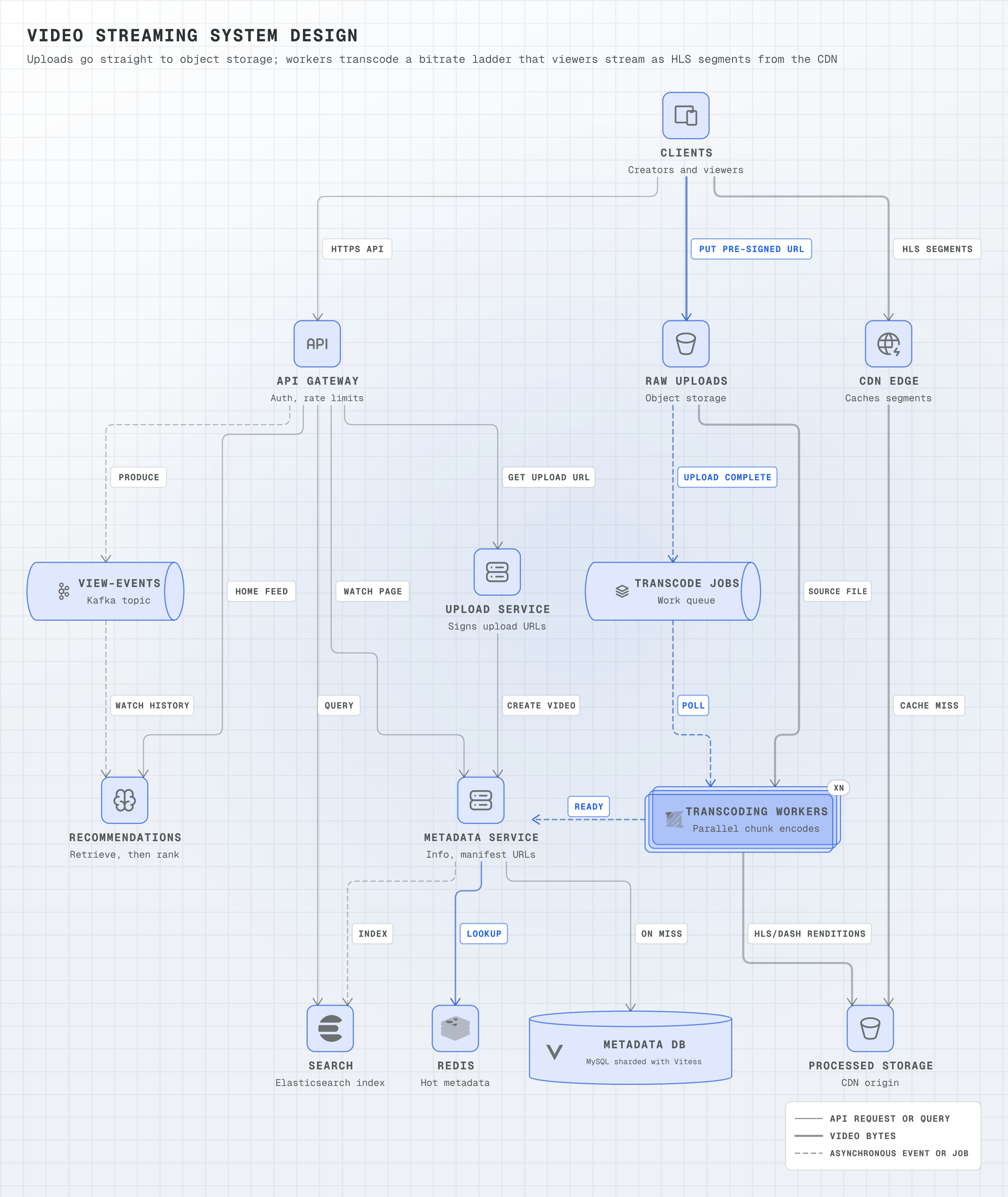
Video streaming system design
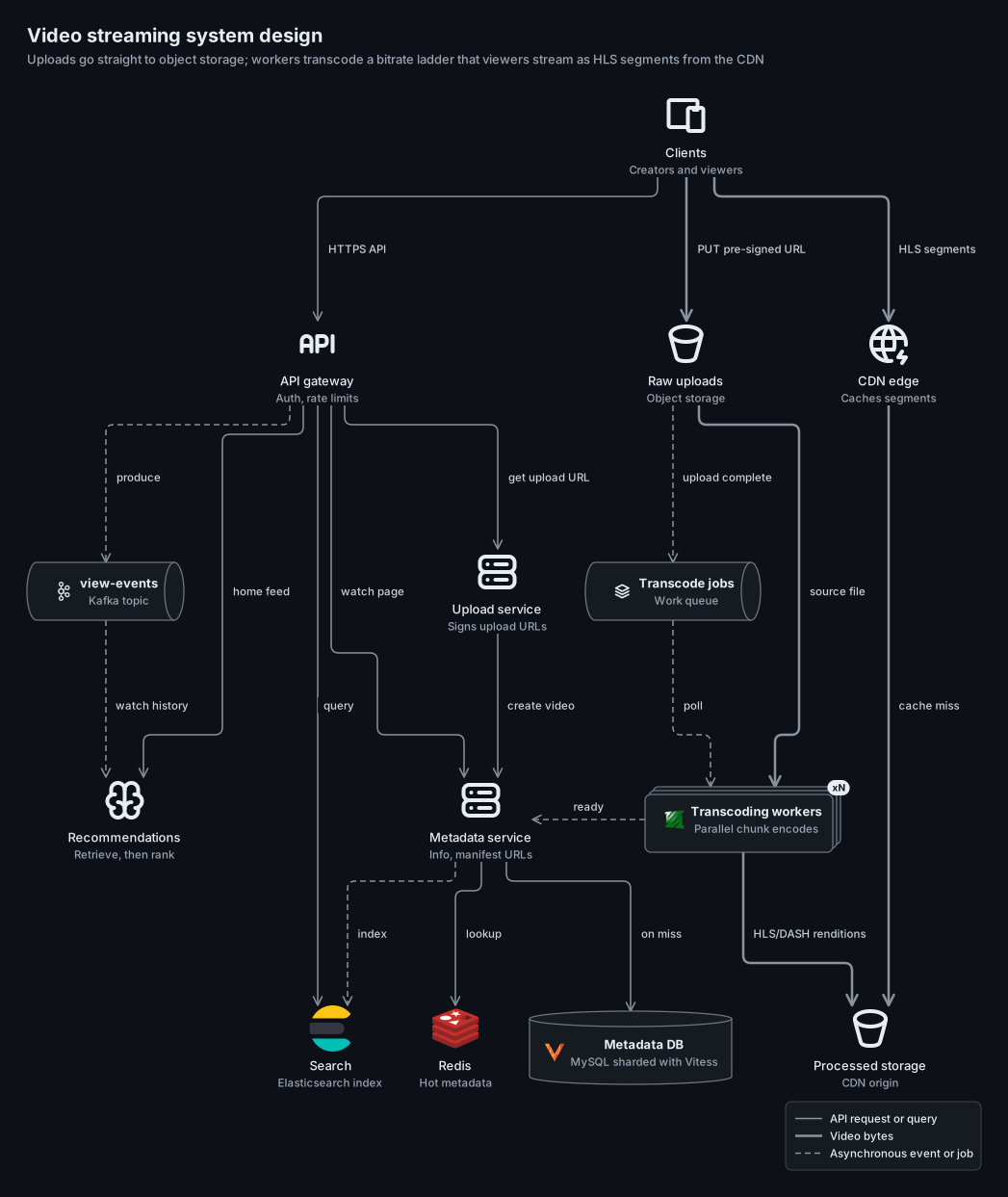
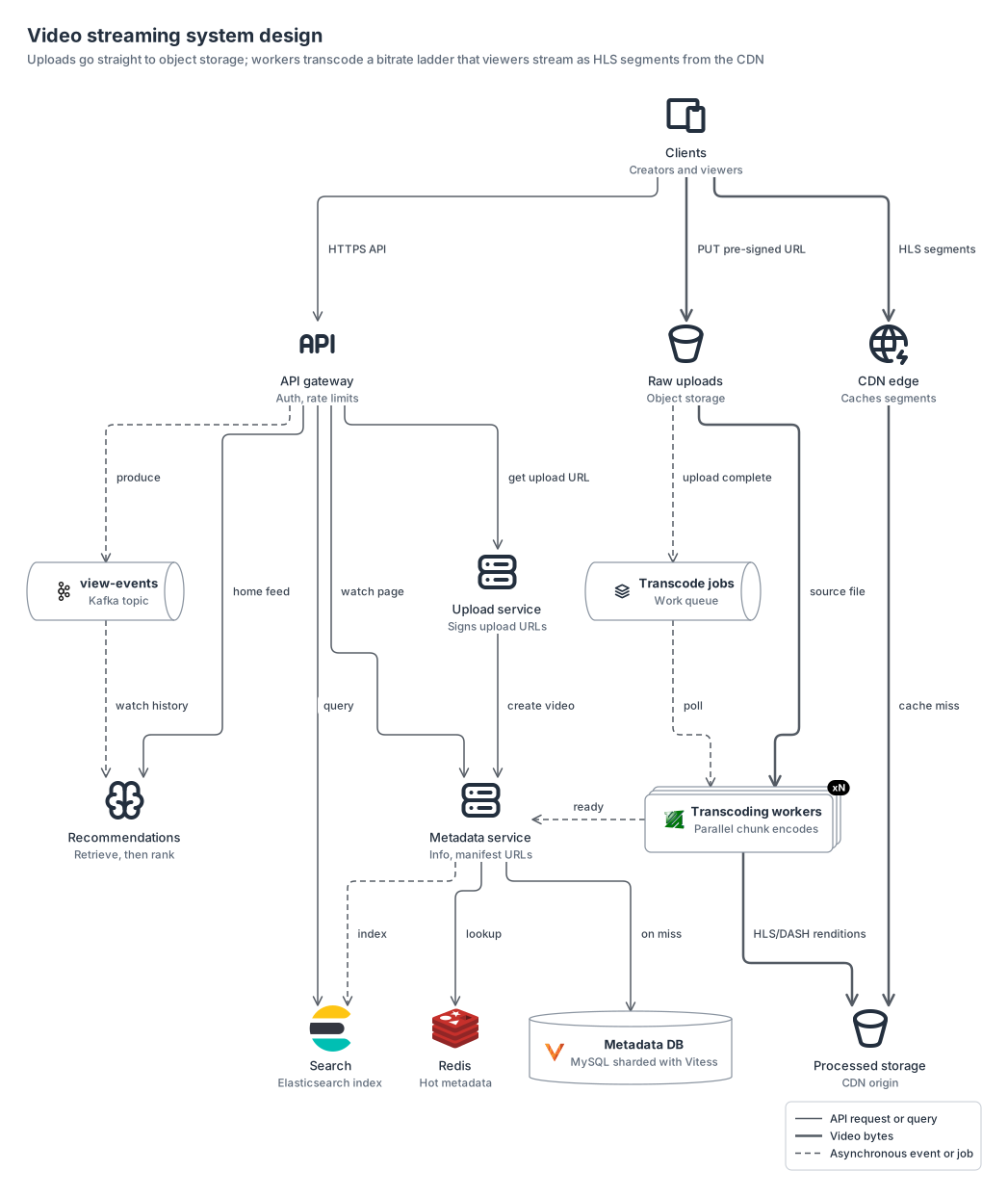
uploads go to object storage through a pre-signed URL, a queue feeds transcoding workers that write HLS and DASH renditions, and viewers stream segments from the CDN while view events flow through Kafka to recommendations.
logostabler14 nodes0 groups19 edges
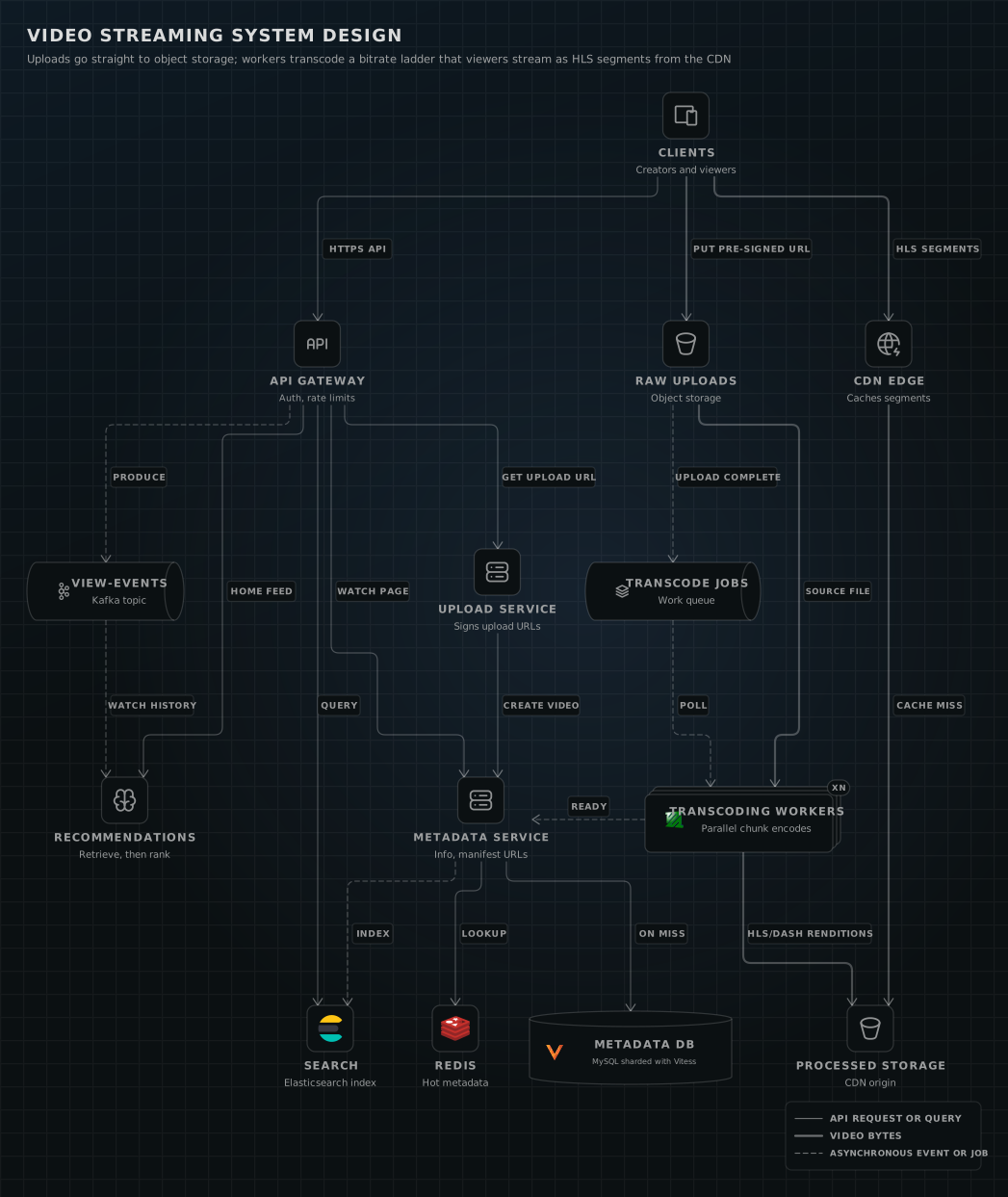
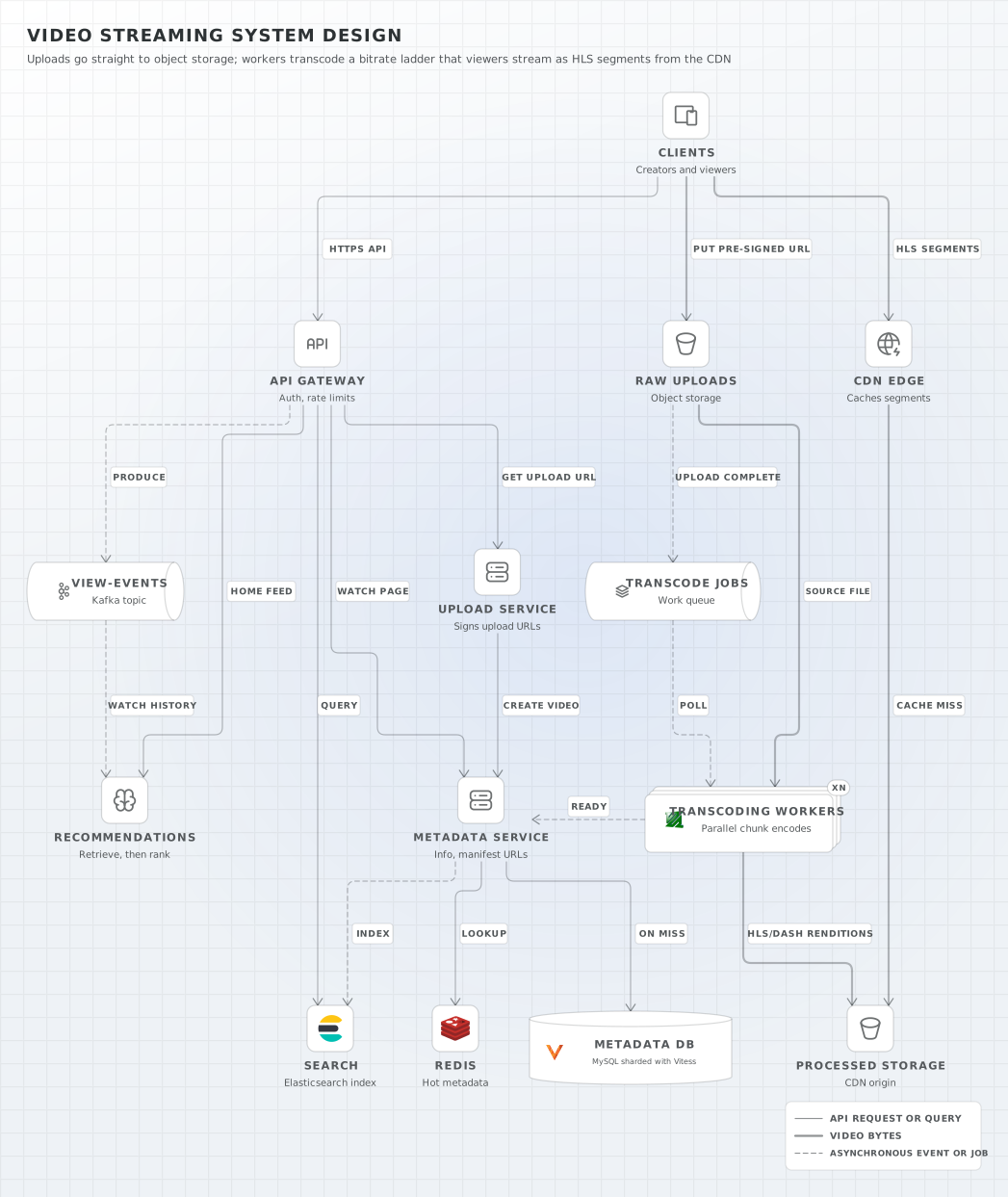
system-design-video-streaming.yamlOn GitHub
# yaml-language-server: $schema=../references/diagram.schema.json
title: Video streaming system design
subtitle: Uploads go straight to object storage; workers transcode a bitrate ladder that viewers stream as HLS segments from the CDN
direction: down
# One port per edge: the API gateway fans out to five services, and merged trunks would hide which call goes where.
layout: { merge: false }

legend:
  solid: API request or query
  thick: Video bytes
  dashed: Asynchronous event or job

nodes:
  clients: { icon: tabler:devices, label: Clients, note: Creators and viewers }
  gateway: { icon: generic:gateway, label: API gateway, note: "Auth, rate limits" }
  # View events and recommendations first, so the watch path keeps the left and the upload pipeline the right.
  events: { shape: queue, icon: logos:kafka-icon, label: view-events, note: Kafka topic }
  recs: { icon: generic:ml, label: Recommendations, note: "Retrieve, then rank" }
  upload: { icon: generic:servers, label: Upload service, note: Signs upload URLs }
  metadata: { icon: generic:servers, label: Metadata service, note: "Info, manifest URLs" }
  search: { icon: logos:elasticsearch, label: Search, note: Elasticsearch index }
  cache: { icon: logos:redis, label: Redis, note: Hot metadata }
  db: { shape: cylinder, icon: logos:vitess, label: Metadata DB, note: MySQL sharded with Vitess }
  raw: { icon: generic:bucket, label: Raw uploads, note: Object storage }
  jobs: { shape: queue, icon: generic:queue, label: Transcode jobs, note: Work queue }
  # A stack reads as a pool of identical workers; each encodes chunks of one video in parallel.
  transcoder: { shape: stack, icon: logos:ffmpeg-icon, label: Transcoding workers, note: Parallel chunk encodes, badge: xN }
  processed: { icon: generic:bucket, label: Processed storage, note: CDN origin }
  cdn: { icon: generic:cdn, label: CDN edge, note: Caches segments }

edges:
  - clients -> gateway: HTTPS API
  # Upload path: the service only signs a URL; the video bytes go straight from the client to object storage.
  - gateway -> upload: get upload URL
  - upload -> metadata: create video
  - clients ==> raw: PUT pre-signed URL
  - raw --> jobs: upload complete
  - raw ==> transcoder: source file
  - jobs --> transcoder: poll
  - transcoder ==> processed: HLS/DASH renditions
  # Drawn after layout, so the callback does not push the metadata service below the workers.
  - { from: transcoder, to: metadata, line: dashed, label: ready, constraint: false }
  # Watch path: the metadata service answers the watch page with a manifest URL, then the player fetches segments from the CDN.
  - gateway -> metadata: watch page
  - metadata -> cache: lookup
  - metadata -> db: on miss
  - metadata --> search: index
  - gateway -> search: query
  - gateway -> recs: home feed
  - gateway --> events: produce
  - events --> recs: watch history
  - clients ==> cdn: HLS segments
  - cdn ==> processed: cache miss
Start from this one
Copies the spec to diagram.yaml, then renders every format.
$ orrery init system-design-video-streaming$ orrery render diagram.yaml -f all --theme both