MLOps on Google Cloud with Agent Platform
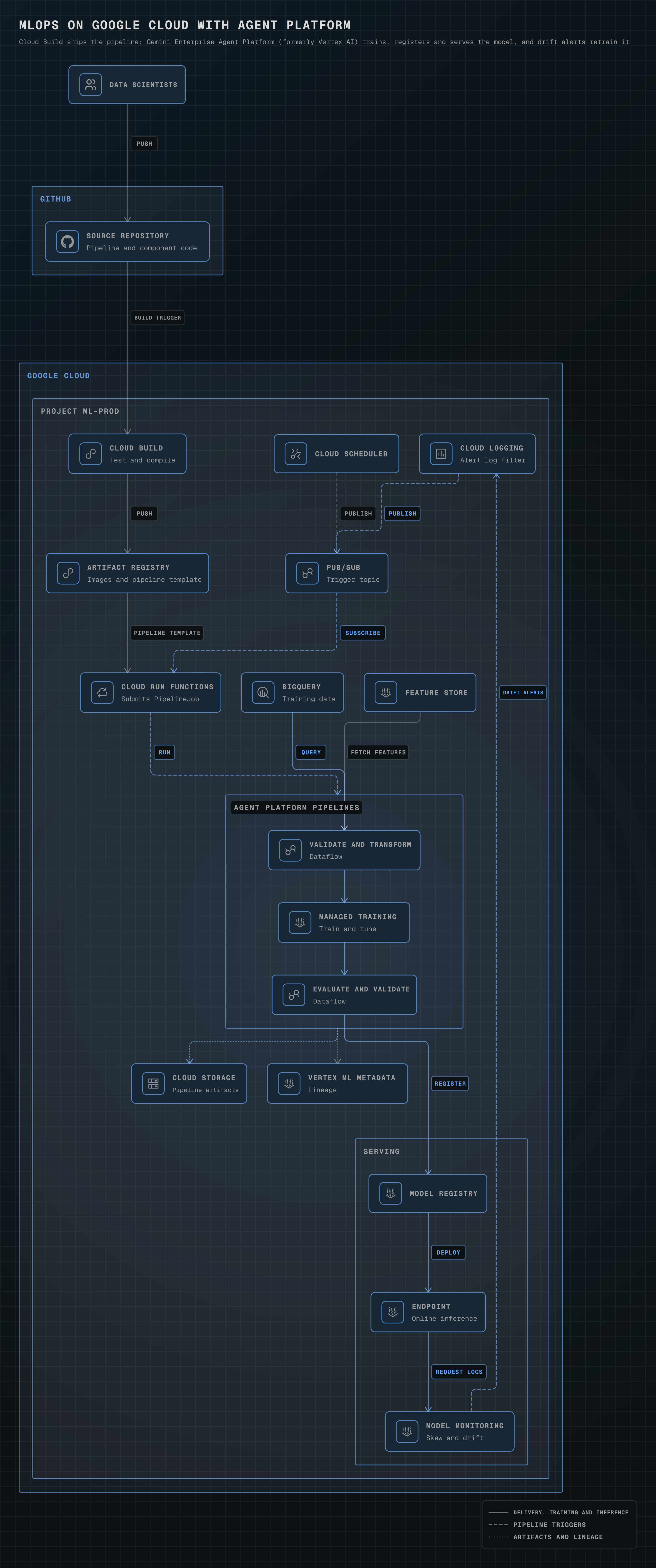
MLOps on Gemini Enterprise Agent Platform (formerly Vertex AI): Cloud Build ships the pipeline, Pub/Sub and Cloud Run functions start it, Dataflow and Managed Training feed Model Registry and an online endpoint, and drift alerts retrain.
gcplogos18 nodes5 groups15 edges
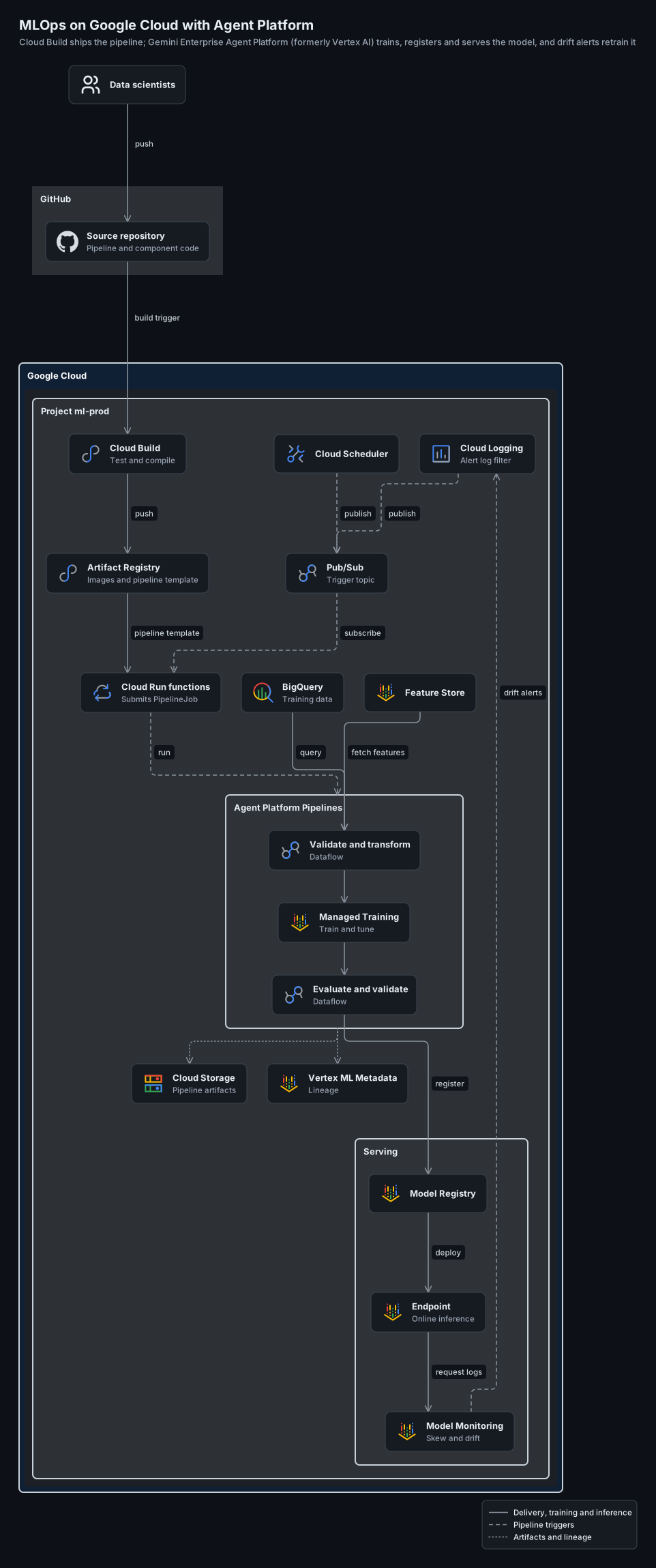
gcp-vertex-mlops.yamlOn GitHub
# yaml-language-server: $schema=../references/diagram.schema.json
# After Google's Cloud Architecture Center "Architecture for MLOps using TensorFlow Extended,
# Agent Platform Pipelines, and Cloud Build": CI/CD with Cloud Build, triggers through Pub/Sub
# and Cloud Run functions, a pipeline that runs its steps on Dataflow and Managed Training,
# and Model Monitoring alerts that start the next run.
title: MLOps on Google Cloud with Agent Platform
subtitle: Cloud Build ships the pipeline; Gemini Enterprise Agent Platform (formerly Vertex AI) trains, registers and serves the model, and drift alerts retrain it
direction: down
# Product cards, as in Google Cloud's own architecture diagrams.
look: card
layout: { spacing: compact, layering: simplex }

legend:
  solid: Delivery, training and inference
  dashed: Pipeline triggers
  dotted: Artifacts and lineage

groups:
  source: { type: gcp:external, label: GitHub }
  gcloud: { type: gcp:cloud }
  project: { type: gcp:project, label: Project ml-prod, in: gcloud }
  pipeline: { type: gcp:tier, label: Agent Platform Pipelines, in: project }
  serving: { type: gcp:tier, label: Serving, in: project }

# Agent Platform services (formerly Vertex AI) draw the Vertex AI core icon from Google's
# product icon download. Cloud Run functions keeps the Serverless Computing icon that the
# icon guide assigns to it under its former name, Cloud Functions.
nodes:
  scientists: { icon: generic:users, label: Data scientists }
  repo: { icon: logos:github-icon, label: Source repository, note: Pipeline and component code, in: source }
  build: { icon: gcp:cloud-build, label: Cloud Build, note: Test and compile, in: project }
  registry: { icon: gcp:artifact-registry, label: Artifact Registry, note: Images and pipeline template, in: project }
  scheduler: { icon: gcp:cloud-scheduler, label: Cloud Scheduler, in: project }
  logging: { icon: gcp:cloud-logging, label: Cloud Logging, note: Alert log filter, in: project }
  topic: { icon: gcp:pubsub, label: Pub/Sub, note: Trigger topic, in: project }
  launcher: { icon: gcp:cloud-functions, label: Cloud Run functions, note: Submits PipelineJob, in: project }
  bigquery: { icon: gcp:bigquery, label: BigQuery, note: Training data, in: project }
  features: { icon: gcp:vertex-ai, label: Feature Store, in: project }
  prep: { icon: gcp:dataflow, label: Validate and transform, note: Dataflow, in: pipeline }
  train: { icon: gcp:vertex-ai, label: Managed Training, note: Train and tune, in: pipeline }
  evaluate: { icon: gcp:dataflow, label: Evaluate and validate, note: Dataflow, in: pipeline }
  artifacts: { icon: gcp:cloud-storage, label: Cloud Storage, note: Pipeline artifacts, in: project }
  metadata: { icon: gcp:vertex-ai, label: Vertex ML Metadata, note: Lineage, in: project }
  models: { icon: gcp:vertex-ai, label: Model Registry, in: serving }
  endpoint: { icon: gcp:vertex-ai, label: Endpoint, note: Online inference, in: serving }
  monitor: { icon: gcp:vertex-ai, label: Model Monitoring, note: Skew and drift, in: serving }

edges:
  - scientists -> repo: push
  - repo -> build: build trigger
  - build -> registry: push
  - registry -> launcher: pipeline template
  - scheduler, logging --> topic: publish
  - topic --> launcher: subscribe
  - launcher --> pipeline: run
  - bigquery -> prep: query
  - features -> prep: fetch features
  - prep -> train -> evaluate
  - evaluate -> models: register
  - models -> endpoint: deploy
  - endpoint -> monitor: request logs
  # The retraining loop climbs back to the triggers; written in layout order with the
  # arrowhead at the start so Cloud Logging stays a publisher beside Cloud Scheduler.
  - { from: logging, to: monitor, arrow: start, line: dashed, label: drift alerts }
  - pipeline ..> artifacts, metadata
Start from this one
Copies the spec to diagram.yaml, then renders every format.
$ orrery init gcp-vertex-mlops$ orrery render diagram.yaml -f all --theme both